Credit Risk Management & Scoring
Understand customer credit risk before it affects collections or payment terms. Quick Receivable brings credit applications, bureau data, and payment behavior together in Salesforce, though your team still makes the final credit decision.
Credit Applications
New or growing accounts submit a credit application. It captures the company details your team needs before setting a limit.
- Status moves from Received to Sent as the application moves along.
- Every application links straight to its Credit Risk Score Card.
- Credit Requests separately track a customer's ask for a new or higher credit limit.
Credit Risk Scoring
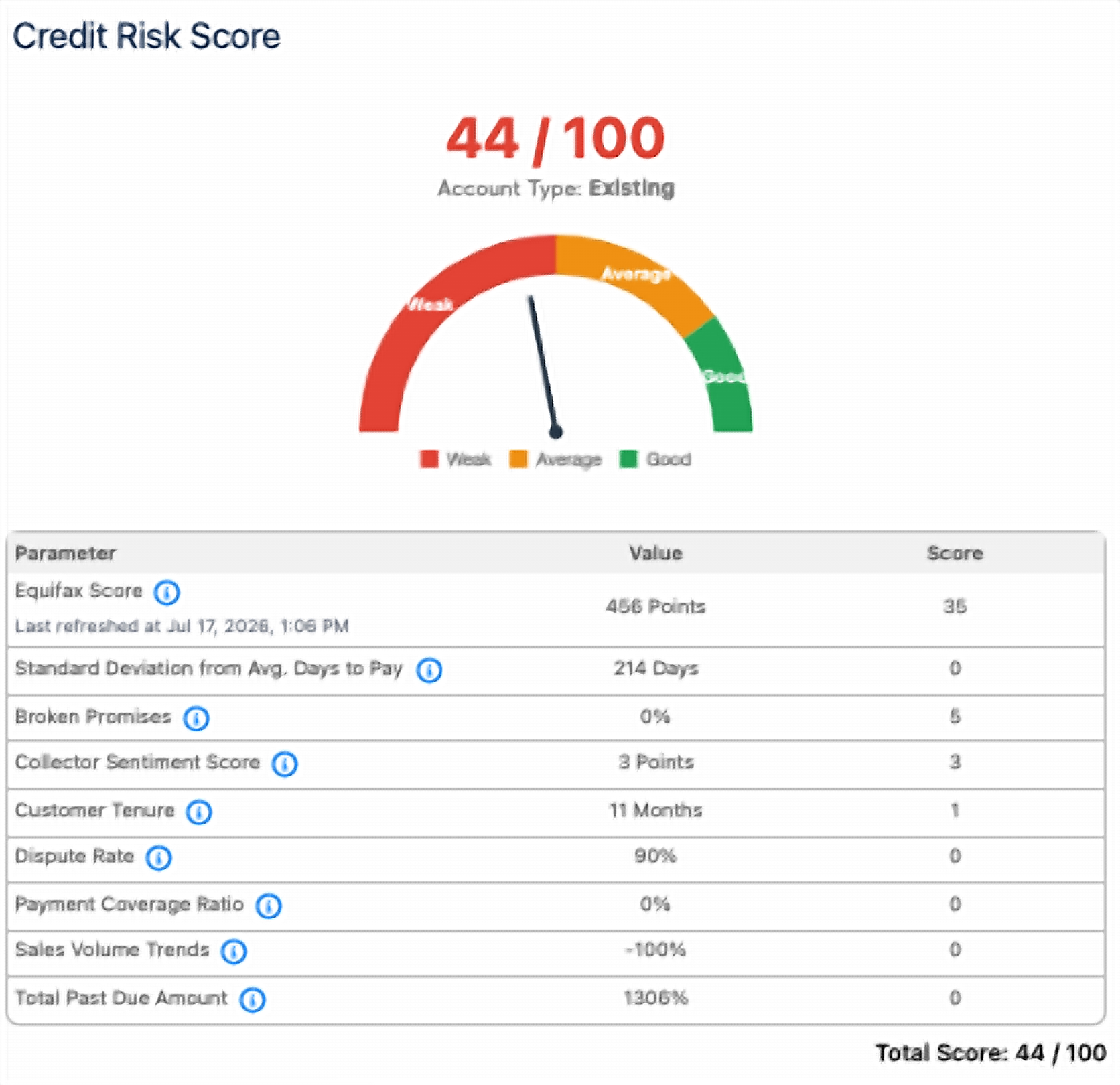
Credit information can be spread across reports and spreadsheets. Quick Receivable brings key credit signals into one score to help your team assess customer risk.
- A credit report pulled from Equifax.
- How steady the customer's payment timing has been.
- How often they've broken a promise to pay.
- Their dispute rate and how long they've been a customer.
These signals combine into one score from 0 to 100, shown on a Weak to Good scale.
Credit Score History
Scores are kept over time, not just as a single snapshot, so your team can see whether an account's credit risk is improving or getting worse before renewing terms.
Your team still decides: the Credit Risk Score is a decision-support signal, not an automatic approval or denial. Final credit decisions are made against your organization's own credit policy.
How Credit Signals Connect to Collections
Payment behavior, broken promises, and disputes tracked elsewhere in Quick Receivable feed directly into the Credit Risk Score, so a customer's collection history informs their credit standing automatically rather than requiring a manual review each time. See Collections & Dunning and Dispute Management for where those signals originate.
Want help setting up credit scoring?
Reach us at info@quickreceivable.com or through our Contact Us page, or book a free demo.