Quick Receivable vs Certinia

Both Run on Salesforce. Only One Is Built Specifically for AR Collections.

BEST VALUE
Logo

Quick Receivable

Dedicated AR Collections

$100 /user/month

Billed annually • All features & AI included

🚀

Live in under 3 months

Fortune 1000 validated

Sits on Top of Your ERP

No need to replace your financial system

Logo

Certinia

Full ERP on Salesforce

Complete financial system: GL, AR Ledger, AP, Billing, Revenue Recognition (ASC 606), PSA, multi-entity & multi-currency.

Replaces or extends your core financial system.

🏗️

Full ERP Implementation

3–12 months deployment • Partner required

📈

Enterprise Pricing

Significant investment and multi-year commitment

Certinia (formerly FinancialForce) is a full ERP and Professional Services Automation platform built natively on Salesforce. It covers the general ledger, accounts receivable, accounts payable, billing, revenue recognition, and project management a complete financial system of record for the Salesforce platform. It is a genuinely powerful product for companies that want to run their entire finance function on Salesforce.

Quick Receivable is a dedicated AR collections automation platform, also built natively on Salesforce. It does not replace your ERP. It automates the collections layer on top of whatever ERP you already run SAP, NetSuite, Certinia, or others bringing AI-powered prioritization, dunning workflows, dispute management, and collector dashboards into the Salesforce org your team works in every day.

If you evaluated Certinia specifically for AR collections automation, you may have found that buying a full ERP is significantly more than the problem you are trying to solve.

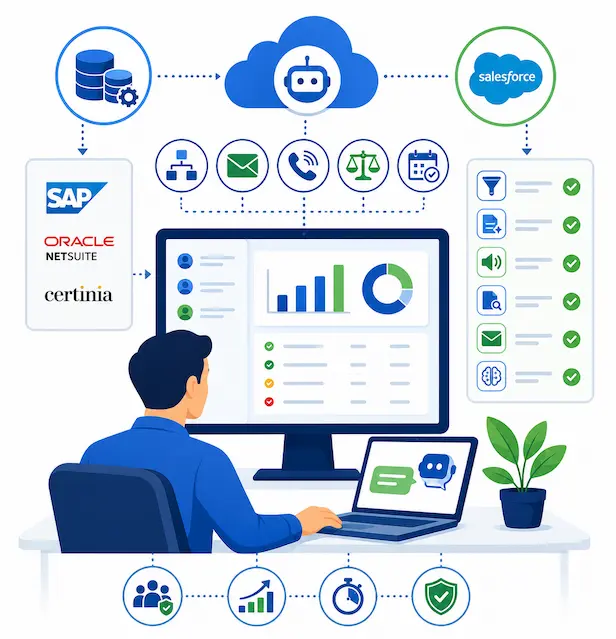
Certinia Replaces Your Financial System. Quick Receivable Automates Your Collections Layer.

This is the most important distinction on this page, and it is not a criticism of Certinia. It is a scope clarification that determines whether either platform is right for the problem you are actually trying to solve.

hero-shape

What Certinia Is Built To Do

Certinia is a financial system of record. Its AR module handles the accounting ledger entries billing customers, recording revenue, applying cash to open invoices, managing multi-entity AR balances. These are ERP-level functions. They are essential. But they are different from AR collections automation: the outreach, prioritization, dispute resolution, and collector workflow management that determines whether your open invoices actually get paid on time.

What Quick Receivable Is Built To Do

Quick Receivable is a collections automation layer. It does not touch your general ledger, your revenue recognition policies, or your chart of accounts. It picks up where your ERP leaves off: taking the open invoices your ERP generates and automating everything that happens between invoice creation and cash receipt prioritizing overdue accounts, sending dunning sequences, tracking disputes, managing collector workflows, and providing live dashboards for finance leadership.

When You Need Certinia

Certinia is the right platform if you want to run your entire financial operation on Salesforce: replace your current accounting system, manage revenue recognition under ASC 606, bill from project milestones, handle multi-entity consolidation, and keep all financial data on the Salesforce platform. It is especially strong for professional services firms with project-based billing and complex revenue recognition requirements.

When You Need Quick Receivable

Quick Receivable is the right platform if your ERP is already in place SAP, NetSuite, Certinia, or others and what you need is a dedicated layer to automate the collections process on top of it. You are not trying to replace your financial system. You are trying to reduce DSO, automate outreach, manage disputes efficiently, and give your collectors the AI tools and dashboards they need to work more effectively.

Running Certinia and need collections automation on top?

Book a 30-Minute Call

AR Automation Comparison: Quick Receivable vs Certinia

Certinia figures based on publicly available information, including AppExchange listings, Certinia.com, and feedback from teams that completed Certinia evaluations. Certinia is a privately held company backed by Salesforce Ventures and Advent International. Verify current Certinia pricing and module scope with their team before deciding.

hero-shape
CRITERIA CERTINIA (ERP CLOUD) QUICK RECEIVABLE
Platform Category Full ERP + PSA on Salesforce: GL, AR, AP, billing, revenue rec Dedicated AR collections automation on Salesforce
Salesforce Architecture Salesforce-native (genuinely built on the platform) Salesforce-native (genuinely built on the platform)
Primary Purpose Replace/extend financial system of record on Salesforce Automate AR collections on top of existing ERP
Replaces Your ERP? Yes designed to be your accounting system No sits on top of your existing ERP
AR Functionality AR ledger, billing, cash application, basic collections management AI prioritization, dunning, disputes, portals, dashboards, all AI tools dedicated collections platform
AI Collections Prioritization Not a primary dedicated feature AI Priority Sorting included per user
Dunning Automation Basic collections functionality within ERP Multi-step configurable dunning workflows, escalation rules
Dispute Management Basic dispute handling within ERP AR module Salesforce-native, full audit trail, real-time dashboards, escalation workflows
Collector Dashboards Finance-level reporting within ERP Dedicated collector and leadership dashboards in real time
AI Email Drafting Not a named feature AI Draft Engine generates follow-up emails from invoice data
AI Document Assistant Not a named feature AI-Doc upload contracts/policies, ask questions, get answers
Revenue Recognition Yes ASC 606 compliance, core ERP feature Not applicable QR is collections-only
PSA / Project Billing Yes Certinia PSA is a core module Not applicable QR is collections-only
General Ledger Yes full GL with multi-entity, multi-currency Not applicable QR is collections-only
Platform Price Enterprise; not published. ~$100–$200+/user/month for ERP suite $100/user/month, billed annually all collections features
Implementation Approach Implementation partner required; 3–12 months Managed by Differenz System; $0–$10K one-time; under 3 months
SAP Integration ERP replaces SAP for mid-market; side-by-side uncommon Native SAP integration, 3x daily delta sync (WillScot production)
Contract Terms Multi-year enterprise contracts typical Annual per-user; volume discount for 50+ users
Free Trial Not standard Available for qualifying teams
Fortune 1000 Reference Not publicly listed at this scope WillScot: Fortune 1000, 175,000 invoices/month, under 3 months
Can They Work Together? N/A (it is Certinia) YES QR can add dedicated collections automation to an existing Certinia ERP deployment
Certinia figures reflect publicly available information and post-evaluation feedback. Certinia was formerly known as FinancialForce and rebranded in October 2023. Verify directly with Certinia for current pricing, module availability, and implementation requirements.

AR Collections Automation Does Not Require Replacing Your Financial System

The cost difference between Certinia and Quick Receivable is not primarily about price per user. It is about what each platform includes. When you purchase Certinia to address AR collections, you are also purchasing the general ledger, accounts payable, revenue recognition engine, multi-entity consolidation, and optionally PSA. For companies that need all of that, Certinia is reasonably priced for its scope. For companies that need AR collections automation specifically, the scope mismatch means the effective cost of the AR collections capability alone is carrying the full ERP.

hero-shape

Certinia: Full ERP Cost

~$100–$200+/user/month

Enterprise ERP suite. Includes GL, AR, AP, billing, revenue rec, multi-entity, optional PSA. Implementation partner required. 3–12 month deployment. Based on publicly available estimates; verify with Certinia.

Quick Receivable: AR Collections

$100/user/month

Billed annually. All collections features, all AI tools. One-time implementation $0–$10,000. Volume discount 50+ users. Collections automation only does not replace your ERP.

What You Keep With QR

Your existing ERP

Quick Receivable runs on top of SAP, NetSuite, Certinia, or your current financial system. Your chart of accounts, revenue recognition, and AP workflows stay exactly where they are.

The Collections Layer That Lives Between Invoice Generation and Cash Receipt

Your ERP generates invoices and records payments. What happens in between the outreach, the follow-up, the dispute resolution, the collector prioritization is the collections layer. That is the gap Quick Receivable fills.

hero-shape

AI Collections Priority Sorting

Analyzes each open invoice against customer payment behavior, invoice age, account value, and historical patterns to rank accounts by collection risk. Collectors start every day with a prioritized action list inside Salesforce. No ERP module generates this automatically.

Multi-Step Dunning Automation

Configurable reminder sequences and escalation rules run automatically based on invoice age, account tier, and risk score. Standard follow-up occurs without collector intervention. Escalation routes to direct handling before invoices age past recovery thresholds.

Dispute Management with Full Audit Trai

Every dispute is opened, assigned, escalated, and resolved inside Salesforce with a timestamped audit log. Finance leadership sees every open dispute and its current status in a live dashboard. No manual spreadsheet. No email thread. Full traceability.

Real-Time Collector and Leadership Dashboards

DSO performance, aging buckets, collector activity, dispute status, and cash application metrics update live inside Salesforce. Your CFO and AR director see the same data as your collectors no exports, no scheduled reports, no version lag.

AI Draft Engine

Generates professional payment follow-up emails from invoice data. Eliminates the daily repetition of writing individual outreach messages while keeping communications clear, accurate, and on-brand for every account regardless of tier or aging bucket.

AI-Doc Contract and Policy Q&A

Upload contracts, credit terms, dispute policies, or billing agreements and ask questions directly. AI-Doc returns answers from the document itself. Your collectors and AR managers get accurate, fact-based answers instantly without searching through long policy files.

Promise to Pay Tracking

Logs customer payment commitments inside Salesforce and automatically monitors whether committed payments arrive on schedule. If a promised payment does not come in, follow-up triggers automatically without manual oversight.

AI Insight Financial Risk Scoring

Monitors payment behavior and credit utilization across your customer base. Assigns risk scores. Surfaces early warning signals before accounts become collection problems.

Fortune 1000 Validation: Dedicated Collections Automation on Top of an Existing ERP

hero-shape

"Quick Receivable has fundamentally transformed how we manage collections, giving us true transparency into our receivables and collector activity while enabling a smooth transition off our legacy platform in under three months. The result is improved accountability, stronger decision-making, and a scalable foundation to modernize credit and collections."

Joshua Nolan, Vice President, WillScot | Fortune 1000 | North America's leading modular space and portable storage provider

WillScot is North America's leading provider of modular space and portable storage solutions and a Fortune 1000 company. They deployed Quick Receivable as a dedicated collections and disputes layer on top of their existing SAP ERP and Salesforce CRM environment. They did not replace SAP. They augmented the collections layer.

The deployment included native SAP integration with three daily delta loads, full data migration from their prior collections platform (GetPaid), and real-time dashboards for collectors, supervisors, and finance leadership all running natively inside their existing Salesforce org. Live in under three months.

Read the full WillScot case study.

View Case Study

Quick Receivable Is the Right Choice If:

  • You already have an ERP (SAP, NetSuite, Certinia, or another system) and need dedicated AR collections automation on top of it, not a new financial system
  • You evaluated Certinia for AR collections and found the full ERP scope GL, AP, revenue recognition, multi-entity, PSA represents far more than the collections problem you are trying to solve
  • Your team runs Salesforce and you want all collections activity, AI tools, disputes, and dashboards to live natively inside your existing Salesforce org
  • You need all six AI collections tools (Priority Sorting, Draft Engine, Tone Adjustment, AI-Doc, Email Classification, AI Insight) included per user without ERP-module-level pricing
  • You need dedicated collector workflows AI prioritization, multi-step dunning, dispute escalation, promise-to-pay tracking, call logging that go beyond what an ERP AR module delivers
  • You already run Certinia ERP and need a dedicated collections automation layer on top of it for collector-facing workflows that Certinia does not deeply automate
  • You need a Fortune 1000-validated implementation path (WillScot, 175,000 invoices/month) that completes in under three months without replacing your financial system
  • Annual per-user billing at $100/user/month with a known implementation fee suits your budget better than an ERP suite contract
  • You want to trial the platform inside your actual Salesforce org before committing to an annual subscription
quickreceivable vs Certinia

Quick Receivable in Production

175,000
Invoices per month at WillScot (Fortune 1000) dedicated collections layer on top of SAP + Salesforce
< 3 Months
WillScot live in under 3 months no ERP replacement, no chart of accounts migration, no financial-system disruption
$0
ERP disruption cost. Quick Receivable adds collections automation on top of your existing ERP. Nothing changes in your financial system.
3x/day
SAP delta sync frequency at WillScot significantly more frequent than the prior once-daily sync

Keep Your ERP. Add Dedicated AR Collections Automation.

We show you Quick Receivable running natively inside a live Salesforce org on top of an existing ERP environment, not replacing it. AI tools active, collections workflows live, Fortune 1000 validated. One 30-minute call. A specific cost for your team.

Book a Free 30-Minute Assessment

Or start a free trial inside your Salesforce org

Questions Finance Teams Ask When Comparing Quick Receivable to Certinia

hero-shape

What is the main difference between Quick Receivable and Certinia?

Certinia (formerly FinancialForce) is a full ERP and Professional Services Automation platform built natively on Salesforce, covering the general ledger, AP, AR ledger, billing, revenue recognition, multi-entity accounting, and optionally project management. Quick Receivable is a dedicated AR collections automation platform, also built natively on Salesforce, that automates the collections layer AI prioritization, dunning, disputes, portals, dashboards on top of whatever ERP you already run. Certinia replaces your financial system; Quick Receivable augments your collections process without touching your financial system.

Can Quick Receivable work alongside Certinia ERP?

Yes. Quick Receivable can sit alongside Certinia on the same Salesforce org, adding dedicated collections automation on top of the AR ledger that Certinia manages. Certinia handles the accounting layer GL entries, billing, revenue recognition. Quick Receivable handles the collector-action layer AI prioritization, dunning sequences, dispute workflows, customer portals, and collector dashboards. These are complementary rather than competing functions for companies already on Certinia ERP.

Both Certinia and Quick Receivable are Salesforce-native. What is the actual difference?

Yes, both platforms are genuinely built on the Salesforce platform this is different from most AR tools that connect to Salesforce via API or AppExchange app. The difference is purpose. Certinia is a financial system of record: it manages your general ledger, accounts payable, revenue recognition, and multi-entity consolidation. Quick Receivable is a collections automation tool: it automates outreach, prioritization, dispute management, and collector workflows on top of the financial data your ERP already manages.

Is Certinia's AR module sufficient for collections automation?

Certinia's AR module handles core AR ledger functions: billing, cash application, and basic collections management within the ERP context. Dedicated AR collections automation AI-powered invoice prioritization, configurable multi-step dunning workflows, dispute management with full audit trails, collector performance dashboards, promise-to-pay tracking, and AI tools for email drafting and risk scoring goes beyond what an ERP AR module typically delivers. This is the gap Quick Receivable fills, either as a standalone tool or alongside an existing Certinia deployment.

How does Quick Receivable pricing compare to Certinia?

Quick Receivable is $100 per user per month, billed annually, with a one-time implementation fee of $0 to $10,000 based on complexity. Volume discounts are available for teams of 50 or more users. Certinia is priced as an enterprise ERP suite; publicly available estimates typically range from $100 to $200 or more per user per month for the full platform. The price difference reflects the difference in scope: an ERP system versus a dedicated collections automation tool. Verify current Certinia pricing directly with their team.

Does Quick Receivable integrate with SAP?

Yes. Native SAP integration with three-times daily delta synchronization is included for all users at no additional cost. WillScot, a Fortune 1000 client, runs this in production. Their SAP data refresh improved from once daily with their prior platform to three delta loads per day with Quick Receivable. Quick Receivable sits on top of SAP it does not replace it.

Who is Certinia best suited for?

Certinia is purpose-built for professional services firms consulting, technology services, staffing, media that want to run their entire financial operation on Salesforce, including project-based billing from time entries and milestones, revenue recognition under ASC 606, multi-entity consolidation, and full GL and AP management. It is also used by software companies with subscription billing and complex revenue recognition needs. For these use cases, Certinia is a strong and focused platform.

Does Quick Receivable handle revenue recognition or general ledger functions?

No. Quick Receivable is a collections automation platform, not a financial system of record. It does not manage revenue recognition, the general ledger, accounts payable, or multi-entity consolidation. These functions remain in your existing ERP SAP, NetSuite, Certinia, or whichever system you currently use. Quick Receivable picks up at the collections layer: the open invoices your ERP generates and the process of getting them paid.

What industries does Quick Receivable serve?

Quick Receivable serves equipment rental, construction, manufacturing, and wholesale distribution companies, along with project-based organizations running SAP and Salesforce. WillScot (modular space and portable storage) is the named Fortune 1000 reference.

Does Quick Receivable require a long-term contract?

No. Quick Receivable is billed annually per user with no multi-year lock-in requirement. Users can be added at any time with prorated charges. Volume discounts are available for teams of 50 or more users.