What Is an Accounts Receivable Ledger?
Understand the accounts receivable ledger, how it ties to the general ledger control account, what each entry records, and how to keep it accurate.
- October 23, 2026
-
 Dadhich Rami
Understand the accounts receivable ledger, how it ties to the general ledger control account, what each entry records, and how to keep it accurate.
Dadhich Rami
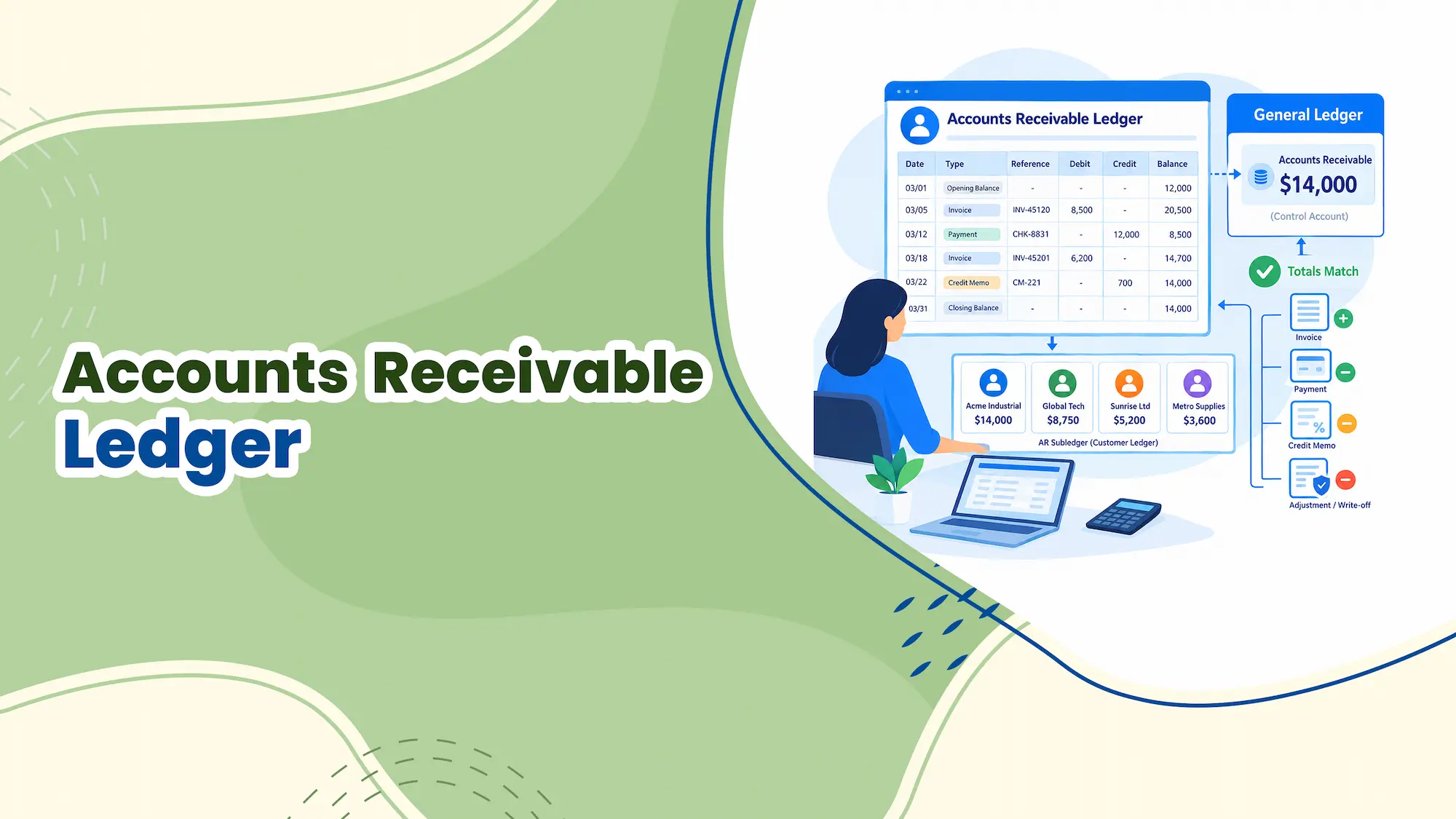
An accounts receivable ledger is a subsidiary ledger that records every amount customers owe a company, with a separate account for each customer. It records each invoice, payment, credit memo, and adjustment that changes a customer's balance. The total of all customer balances in the AR ledger should equal the accounts receivable control account in the general ledger.
The AR ledger records every receivable transaction for each customer, while the general ledger holds a single accounts receivable control account that summarizes all customers. The AR ledger answers what each customer owes and for which invoices; the general ledger control account answers what total accounts receivable is. Both should show the same total on any date.
| Item | AR Ledger (Subledger) | General Ledger Control Account |
|---|---|---|
| Detail level | Each customer and each transaction | One total for all customers |
| Used by | AR team, collectors, credit team | Accounting and financial reporting |
| Answers | What does this customer owe, and for which invoices? | What is total accounts receivable? |
| Feeds | Aging reports, statements, collections | Trial balance, balance sheet |
Confirming that the two totals match each period is the purpose of accounts receivable reconciliation.
The AR ledger is also called the AR subledger, AR subsidiary ledger, customer ledger, or sales ledger.
An accounts receivable ledger records, for each customer, the customer name and ID, transaction date, transaction type, reference number, debit or credit amount, running balance, and the due date and payment terms of each invoice. Transaction types include invoices, payments, credit memos, adjustments, and write-offs.
Invoices are recorded as debits because they increase what the customer owes. Payments, credit memos, and write-offs are recorded as credits because they reduce it. For a fuller explanation of these rules, see is accounts receivable a debit or credit.
The example below shows one customer account for March. Acme Industrial starts the month owing $12,000, receives two new invoices, makes one payment, and receives one credit memo. Its closing balance of $14,000 is this customer's contribution to the general ledger control account.
| Date | Type | Reference | Debit | Credit | Balance |
|---|---|---|---|---|---|
| 03/01 | Opening balance | — | — | — | $12,000 |
| 03/05 | Invoice | INV-45120 | $8,500 | — | $20,500 |
| 03/12 | Payment | Check 8831 | — | $12,000 | $8,500 |
| 03/18 | Invoice | INV-45201 | $6,200 | — | $14,700 |
| 03/22 | Credit memo | CM-221 | — | $700 | $14,000 |
| 03/31 | Closing balance | — | — | — | $14,000 |
Adding the closing balances of every customer gives the AR ledger total, which should equal the general ledger accounts receivable balance.
Each AR ledger entry has a matching general ledger entry. An invoice debits the customer account and, in the general ledger, debits accounts receivable and credits revenue. A payment credits the customer account and debits cash while crediting accounts receivable. A credit memo credits the customer account and credits accounts receivable against sales returns or revenue. A write-off credits the customer account and credits accounts receivable against the allowance for doubtful accounts.
In most accounting systems, posting a transaction to a customer account posts the matching general ledger entry automatically. Problems start when an entry is made directly in the general ledger without customer-level detail. For the full set of entry formats, see our guide to accounts receivable journal entries.
The AR ledger shows every transaction, open or closed, organized by customer and date, while the AR aging report shows only open items, organized by customer and age bucket as of a single date. The ledger provides the full history and audit trail; the aging report shows what is outstanding and how overdue it is. The aging report is built from the ledger.
Using the Acme Industrial example with an aging date of March 31, only the open items carry into the aging. The $12,000 opening balance was paid on March 12, so it does not appear. Invoice INV-45120 for $8,500 is due April 4 and invoice INV-45201 for $6,200 is due April 17, so both are current, and the $700 credit memo reduces the current bucket. The aging total of $14,000 matches the ledger's closing balance.
The AR ledger is important because it is the source of truth for what each customer owes. Collectors use it to know which invoices to ask about, customer statements and the aging report are generated from it, credit teams use its payment history to assess risk, dispute teams use it to identify the invoices and payments involved, and auditors trace its balances to invoices and payments when testing receivables.
A credit balance in the AR ledger means the company owes the customer money rather than the customer owing the company. Common causes are overpayments, duplicate payments, payments applied before the invoice was posted, credit memos larger than the open invoices, and payments applied to the wrong customer.
Credit balances should be reviewed monthly. Overpayments and duplicates are refunded or applied to future invoices with the customer's agreement, and misapplied payments are reversed and reapplied. Large or old credit balances may need to be reclassified as a liability for reporting and, if unclaimed, may fall under state unclaimed property rules.
The most common AR ledger errors are payments applied to the wrong customer, payments recorded but not applied to invoices, duplicate invoices, credit memos that were never posted, and manual general ledger entries with no matching ledger detail. Each one either misstates individual customer balances or causes the AR ledger total to differ from the general ledger.
The AR ledger stays accurate with restricted posting rights, approval requirements for credit memos and write-offs, segregation of duties between applying cash and approving adjustments, locked accounting periods, a complete audit trail of who posted each entry, and a monthly reconciliation to the general ledger. These are standard audit expectations for receivables and also reduce month-end corrections.
To keep the AR ledger accurate, apply payments to specific invoices daily, post approved credit memos immediately, restrict direct posting to the general ledger accounts receivable account, reconcile the ledger to the general ledger at least monthly, and review customer credit balances regularly.
A shared view of receivables also reduces errors, because collections, credit, and finance see the same balances and notice inconsistencies sooner. An accounts receivable dashboard gives each team the same current data.
40%
DSO reduction70%
less manual work95%
cash match accuracyFind out exactly how much time and money your AR team can save with Quick Receivable. No commitment, no setup required.

AI-powered Accounts Receivable Automation on Salesforce, built to accelerate collections, automate workflows, and improve cash flow.