Quick Answer: What Is the Order to Cash Process?
The order to cash process is the end-to-end sequence of steps a company follows from the moment a
customer places an order to when payment is received and reconciled. It includes order management,
credit assessment, fulfillment, invoicing, collections, dispute resolution, and cash application.
Optimizing each stage reduces DSO, improves cash flow, and lowers bad debt exposure.
Most CFOs know their revenue numbers cold. But ask them where cash gets stuck between a signed contract
and a cleared payment, and the answer gets messy fast. The order to cash process sounds straightforward on
paper. A customer orders. You fulfill. You invoice. They pay. Done.
Except it's never that clean. In reality, the order to cash cycle touches sales, operations, finance, and
customer service simultaneously. A misstep in any one stage doesn't just slow one invoice; it creates a
ripple that shows up in your DSO, your working capital, and your Q3 forecast conversation with the board.
Understanding where the friction lives is the first step to fixing it.
What the Order to Cash Process Actually Covers
The order to cash (O2C) cycle is the complete sequence of business processes that starts the moment a
customer places an order and ends when that payment is posted and reconciled in your books. It's not just
an AR function. It spans your entire revenue operation.
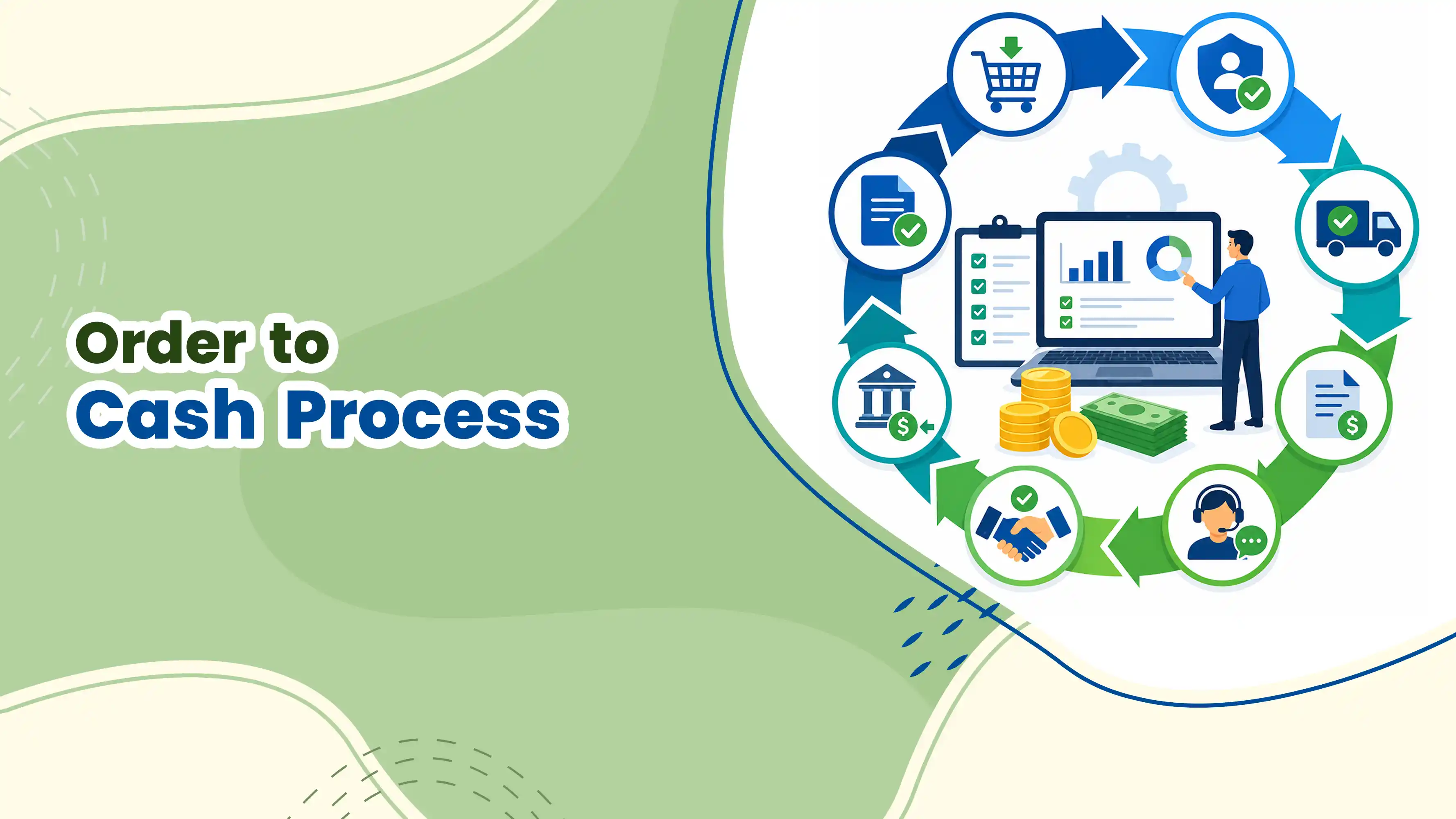
Here are the core stages most enterprise finance teams would recognize:
- Order Management - Customer order received, validated,
and entered into the system
- Credit Management - Customer creditworthiness
assessed; credit limits checked or set
- Order Fulfillment - Product ships, service is
delivered, or equipment is deployed
- Invoicing - Invoice generated and sent to the customer
- Collections - Payment follow-up, reminders, and
escalation if needed
- Dispute Management - Deductions, short payments, and
billing discrepancies resolved
- Cash Application - Incoming payments matched to open
invoices
- Reporting and Reconciliation - AR aging, DSO tracking,
close-out
Each stage depends on the one before it. And in most mid-market to enterprise companies, these stages are
handled by different teams, different tools, and sometimes different systems entirely.
That's where the trouble starts.
Where the Process Breaks Down in Practice
The Credit Check Nobody Has Time to Run
Picture this: your sales team closes a $400K equipment rental deal on a Friday afternoon. The contract
goes into the system, fulfillment starts Monday. Three months later, you're looking at a 90-day-past-due
balance because nobody ran a proper credit check on the new account. The customer has a history of slow
payment. Your credit team would have flagged it. But the order moved faster than the process.
This isn't rare. In industries like construction and manufacturing, where deals close quickly and project
timelines drive urgency, credit management often gets compressed or skipped. The downstream cost, in bad
debt and collection time, is significant.
Tying credit management directly into your AR workflow means new orders trigger automatic credit reviews
before fulfillment begins. No manual handoffs. No missed flags.
Invoicing Delays That You Don't Even Know Are Happening
Here's the thing about invoice timing: every day between delivery and invoice delivery is a day you've
extended free credit. In distribution or manufacturing, where volume is high and invoices go out in
batches, a two or three day lag across thousands of invoices adds up to real cash flow drag.
Worse, invoices sent to the wrong contact at a large enterprise customer often sit in someone's inbox for
weeks before reaching the AP team. Then the clock on payment terms hasn't even started yet.
Real-time invoice
tracking isn't just an operational convenience. It's a cash flow lever.
Collections Without Prioritization
Your collections team has 200 open accounts. They've got the aging report in front of them. And they're
working through the list the same way they did last month and the month before, calling accounts in rough
order of balance size or due date.
The problem? Not every overdue account carries the same risk. A $50K invoice that's 31 days past due with
a customer who has a clean payment history is very different from a $22K invoice that's 35 days past due
with a customer who disputed their last three invoices.
Without intelligent prioritization, collectors spend time on the wrong accounts. High-risk balances age
further. Bad debt provisions increase. Improving how you manage accounts
receivable requires treating collections as a risk-management function, not just a calling queue.
Disputes That Stall the Whole Cycle
Disputes are the order to cash process's biggest hidden cost. A customer deducts $8,500 from a payment
with a vague reference to a pricing discrepancy. Your AR team flags it. It goes into a shared mailbox.
Someone has to dig through the original order, the shipping confirmation, the rate card, and any previous
communications.
Meanwhile, that balance sits open. It inflates your DSO. It shows up wrong in your aging. And if the
dispute drags past 90 days, the likelihood of full collection drops sharply.
Effective dispute
management in accounts receivable requires a structured workflow, clear ownership, and a way to
track resolution time. Most companies have none of the three.
Cash Application Backlogs at Month-End
End of month. Payments are coming in fast. Your cash application team is matching remittances manually,
cross-referencing bank statements, hunting down check stubs and ACH details. Partial payments, lump-sum
checks covering 14 invoices, wire transfers with no remittance attached.
In high-volume environments, this creates a genuine bottleneck. Unapplied cash sits in a suspense
account. AR balances look inflated. Finance can't close the books cleanly until it's sorted. If your
company processes thousands of invoices a month, this isn't a minor inconvenience. Understanding what cash
application actually involves makes clear why manual processes don't scale.
The Real Cost of an Inefficient O2C Cycle
A slow or broken order to cash process isn't just an AR problem. It's a working capital problem that
affects every financial decision you make.
When cash is tied up in open invoices longer than it should be, you're essentially funding your
customers' operations. You have less liquidity for investment, acquisitions, or debt paydown. Your DSO
creeps up. Your borrowing costs go up. And your finance team spends its energy managing symptoms instead
of strategy.
The relationship between AR management and cash flow is direct you can dig into how accounts receivable affects cash
flow in detail, but the short version is simple: the longer invoices sit open, the more pressure
you're absorbing on behalf of your customers.
For a concrete look at where your current cycle is losing money, the AR ROI calculator at Quick
Receivable is worth running through. It puts real numbers on the gap between your current performance and
where you could be.
What a Well-Run Order to Cash Process Looks Like
Before Automation vs. After Automation
Before:
- Credit checks done manually, often after the sale closes
- Invoices generated in batches, delivered 2-3 days after
fulfillment
- Collections run from static aging reports, no prioritization
logic
- Disputes tracked in email threads and spreadsheets
- Cash application handled manually at month-end, often a 3-5
day process
After:
- Credit assessments triggered automatically at order creation
- Invoices generated and delivered same day, with delivery
confirmation
- Collections prioritized by AI-based risk scoring, collector
time focused on highest-risk accounts
- Disputes routed automatically with SLA tracking and owner
assignment
- Cash application auto-matched with AI, exceptions flagged for
human review
The difference isn't incremental. It's structural. Companies that have tightened their O2C process
consistently report measurable DSO reduction and lower bad debt. You can see the specifics in how to reduce days
sales outstanding and in the case
studies from companies that have done it.
How Technology Fits Into the Order to Cash Equation
Why Salesforce-Native Matters More Than You Think
Most enterprise companies already run their customer relationships, contracts, and sales activity in
Salesforce. The disconnect happens when AR lives in a separate system. Collections teams work in one tool.
Sales data lives in another. Customer service disputes land in a third. Nobody has a complete picture of
the customer.
A Salesforce-native AR automation platform
eliminates that gap. Collections agents, credit managers, and dispute resolution teams work inside the
same customer record that sales and service already use. No integrations that break. No re-keying data. No
version lag between systems.
Quick Receivable is built entirely within
Salesforce. That means your order to cash data and your CRM data live together. A collector calling on a
past-due account can see the open support ticket from the same customer in the same screen. That context
changes the conversation.
AI Agents Across Every Stage
Platforms like Quick Receivable are deploying AI agents at each stage of the O2C cycle, not just
collections. AI for credit risk scoring at order creation. AI for invoice matching and cash application.
AI for dispute classification and routing. AI for identifying which accounts are at highest risk of
default based on payment behavior patterns.
This isn't theoretical. Finance automation tools built on
this model are already processing billions in AR annually for Fortune 1000 companies.
The question worth asking isn't whether your company needs this. It's whether you can afford another year
of your current process.
Measuring Order to Cash Performance
You can't manage what you don't measure. The most useful KPIs for tracking O2C health include:
- Days Sales Outstanding (DSO) - How long it takes to
collect after a sale. Your single most important O2C metric. Understanding DSO deeply is
foundational to any O2C improvement effort.
- Collection Effectiveness Index (CEI) - Measures how
much of your collectible AR was actually collected in a period.
- Dispute Rate - Percentage of invoices that generate a
dispute or deduction.
- Cash Application Accuracy - How much AR gets matched
automatically vs. requires manual intervention.
- Invoice-to-Cash Cycle Time - End-to-end time from
invoice delivery to payment posted.
Tracking these consistently, and benchmarking them against your industry, shows you where the cycle is
leaking. For a broader view of what metrics matter and why, the AR KPIs guide breaks this
down in practical terms.
Conclusion
The order to cash process doesn't fail all at once. It erodes. A credit check skipped here. An invoice
delayed there. A dispute that sat in a shared mailbox for three weeks. Individually, each issue looks
manageable. Together, they're what's keeping your DSO elevated and your cash flow tighter than it should
be.
The companies that have fixed this haven't done it by working harder. They've done it by building systems
where each stage of the cycle is automated, connected, and visible in real time. If you're ready to see
what that looks like for your specific environment, schedule a conversation with the Quick Receivable team. No pressure, no
canned demo, just a real look at where your O2C cycle stands and what's possible.
Frequently Asked Questions
The order to cash (O2C) process covers every step from customer order
to collected payment, including credit checks, invoicing, collections, dispute resolution, and
cash application. For CFOs, it's a direct driver of working capital and cash flow. A slow O2C
cycle inflates DSO, ties up liquidity, and forces the business to carry more risk than
necessary. Improving it isn't just an AR efficiency goal - it's a strategic finance priority.
The biggest bottlenecks tend to cluster around four areas: late or
inaccurate invoicing, collections teams working without intelligent prioritization, dispute
resolution processes with no formal workflow or ownership, and manual cash application that
creates month-end backlogs. In high-volume environments like distribution or manufacturing, all
four can occur simultaneously, creating compounding delays in cash conversion.
Automation reduces DSO by eliminating the time delays built into manual processes. Invoices go
out faster. Collections follow-up starts earlier and focuses on highest-risk accounts first.
Disputes are routed and resolved with defined SLAs instead of sitting in email. Cash gets
applied same-day rather than in batches. Each improvement shortens the time between delivery and
collected cash, which is what DSO measures.
It depends heavily on the platform. Legacy enterprise AR systems often
require 9 to 12 months for implementation, extensive IT involvement, and complex integrations.
Salesforce-native platforms like Quick Receivable can go live in as little as 4 weeks because
they deploy within your existing Salesforce environment, eliminating the need to build data
bridges between systems. Faster deployment means faster ROI.
Any industry with high transaction volume, complex billing, or
extended payment terms benefits substantially. Equipment rental, construction, manufacturing,
and wholesale distribution see particularly strong results because these sectors combine high
invoice volume with the risk of disputes, deductions, and slow-paying enterprise customers. The
combination of volume and complexity is exactly where automation delivers the biggest return.
 Shyam Agarwal