• Home   »  
  • Blog   »  
  • Dispute Management in Accounts Receivable: A Practical Guide

Dispute Management in Accounts Receivable: What's Breaking It and How to Fix It

Dispute management in accounts receivable drains cash flow and wastes collector hours. See how AR teams resolve invoice disputes faster and get paid. Learn how.

Dispute Management in Accounts Receivable: A Practical Guide

Most AR teams underestimate how much invoice disputes cost them. It's not just the delay on that one disputed invoice. It's the collector who spends 40 minutes digging through email threads to find the original PO, the deduction that sits in a gray zone for six weeks because nobody owns it, and the customer who gets frustrated and starts treating your invoices as optional. Dispute management in accounts receivable is one of those problems that looks containable until you add it all up.

The NACM puts average DSO for US companies around 38 days, but for companies dealing with high dispute rates, collections often stall well past 60. That gap is expensive.

Here's the thing: most disputes aren't caused by bad customers. They're caused by process failures your team created, often unintentionally.

Why Invoice Disputes Happen More Than They Should

Let's be honest about where disputes actually come from. Pricing mismatches, short shipments, proof-of-delivery gaps, duplicate billing errors, and misapplied credits account for the vast majority of what lands in a dispute queue. These aren't mysterious. They're traceable.

Take a mid-sized wholesale distributor in the Midwest. They're sending 8,000 invoices a month. Their ERP shows one price for a line item; the customer's procurement system shows another because there was a contract amendment six months ago that never made it into the ERP correctly. The invoice goes out, the customer short-pays by $340, and now that $340 sits aging for 45 days while two people argue over which system is right. Multiply that by a few hundred instances a month and you've got a real cash flow problem.

Construction is even messier. Progress billing, lien waivers, change orders, retainage calculations. Any one of those can trigger a dispute. And when a GC pushes back on a $22,000 draw because they claim the milestone wasn't met, that's not a collections problem; it's a documentation and workflow problem that your AR team is now left to untangle.

The invoice itself is rarely the problem. The process around it is.

What a Broken Dispute Management Process Actually Looks Like

You know your dispute process is struggling when your collectors spend more time as researchers than collectors. When every dispute requires a phone call to find out what the customer actually received. When disputes live in email and spreadsheets, owned by no one, tracked inconsistently.

A collector at a large equipment rental company once described her morning to me: she'd log in, scan her aging report, and immediately set aside the flagged invoices because she knew they'd take her most of the day. Not because the disputes were complex, necessarily, but because the information was scattered. The original order was in Salesforce. The delivery confirmation was in a different system. The customer's dispute reason was in her inbox. Pulling it all together for a $1,200 invoice took two hours.

That's a real pattern. And it repeats across industries.

A few symptoms worth watching for in your own operation: dispute resolution cycle times above 14 days, collectors who can't tell you at any given moment how many open disputes they have, disputes that get "resolved" by just writing off the balance, and customers who have learned that disputing an invoice is a good way to delay payment indefinitely.

Sound familiar? If you're reviewing accounts receivable aging reports regularly and seeing the same accounts in dispute month after month, the problem isn't those customers. It's your process.

The Core Components of Effective AR Dispute Management

So what does a functional dispute management process actually need? Four things, mostly.

First, a structured intake. Every dispute needs to be logged with a reason code, a dispute amount, a creation date, and an owner. The moment a dispute becomes a "thing I need to follow up on" rather than a tracked record, it starts slipping. Reason codes matter more than most teams realize; without them, you can't identify root causes or spot patterns.

Second, supporting document access. If your collector has to go to three different systems to retrieve the PO, the delivery receipt, and the original invoice, you're adding friction to every single dispute. The resolution depends on documentation. If that documentation is hard to pull, resolution takes longer. Simple as that.

Third, defined escalation paths. Not every dispute should go to the same person. A $450 pricing discrepancy and a $180,000 disputed progress payment are very different situations. Your process needs to know the difference and route accordingly.

Fourth, customer communication workflows. How quickly you respond to a dispute, and how clearly you communicate its status, directly affects how quickly customers pay the undisputed portion of their balance. Customers who feel their dispute is being handled professionally tend to pay faster on the clean invoices.

A strong accounts receivable management strategy has to treat dispute resolution as a workflow problem, not a people problem.

How Dispute Management Connects to DSO and Cash Flow

Here's a number to sit with: companies with mature dispute management processes typically see dispute resolution times 40 to 60 percent shorter than those running manual processes. That's not a trivial difference when you're operating at enterprise scale.

Every day a disputed invoice stays open, the cash it represents is unavailable. If you're a $400M manufacturer with 3% of your AR sitting in dispute at any given time, that's $12M in locked receivables. At a cost of capital of 6%, that's roughly $720,000 a year in carrying cost, just from disputes you're not resolving quickly.

There's a direct line between dispute cycle time and days sales outstanding. Your DSO calculation doesn't care whether a receivable is aging because a customer won't pay or because an internal dispute is unresolved. It just ages.

If you want to reduce days sales outstanding in any serious way, dispute management is one of the highest-leverage places to start. Automation helps, but the bigger win is process structure.

The Deduction Problem: A Dispute Category Worth Calling Out Separately

Deductions deserve their own mention because they're a particularly costly form of dispute that high-volume B2B companies deal with constantly. Retailer chargebacks, short-pay deductions, promotional deductions. These aren't disputes in the traditional "customer is unhappy" sense; they're deductions the customer takes unilaterally, often without telling you what they're for.

Managing deductions well requires the same things as general dispute management, but with a few extras: matching logic that can tie a deduction back to a promotion agreement or an approved claim, and a clear policy on what gets approved versus what gets pushed back on.

The deduction process in accounts receivable is worth understanding on its own terms if your team deals with high deduction volumes. It's a separate workflow, but it's broken in similar ways when companies are running it manually.

What Automation Actually Changes About Dispute Management

Automation doesn't eliminate disputes. Let's be clear about that. What it does is compress the time from dispute creation to resolution, give your collectors better information faster, and make it much harder for a dispute to fall through the cracks.

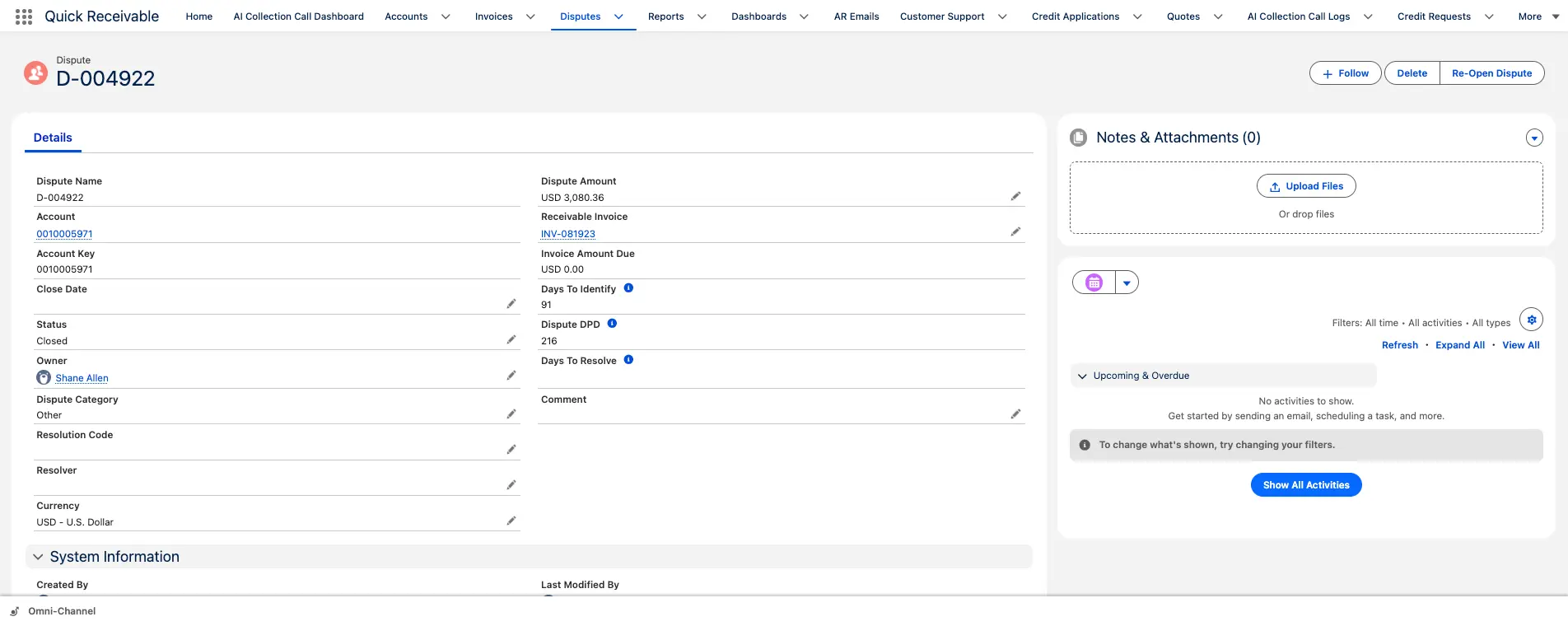
The practical changes are real. Automated dispute intake captures the reason code, creates the record, and routes it to the right owner without anyone having to remember to do that. AI-assisted matching can pull the relevant PO, contract, or delivery document and attach it to the dispute record automatically. Communication templates can go out within hours of a dispute being logged, telling the customer it's been received and is under review.

That's not magic. But it removes a lot of the manual friction that makes dispute management so slow in most organizations.

Quick Receivable, which is built natively on Salesforce, includes an AI-powered Dispute Management agent that handles exactly this kind of workflow automation. Because it lives inside Salesforce, your collectors aren't toggling between platforms, and every dispute record is tied to the customer account where all the other relationship data already lives. For Fortune 1000 companies in industries like equipment rental, construction, and manufacturing, that kind of native integration matters more than most people realize before they try to implement something that isn't native.

If your team is evaluating AR automation options, it's worth reading up on accounts receivable automation to understand what meaningful automation actually looks like versus what vendors tend to oversell.

Building a Dispute Management Process That Holds Up at Scale

If you're managing 50 invoices a month, you can probably handle disputes manually and get away with it. At 5,000 invoices a month, a manual process is a liability.

Scaling dispute management requires a few deliberate choices. Standardize your reason codes before you do anything else. Five to eight codes cover the vast majority of disputes in most industries. Without standard codes, every dispute is a snowflake and you can't learn from patterns. Build an SLA into your process. A dispute logged today should have a first response by tomorrow and a resolution target within some defined window, seven days, ten days, whatever your business can support. Track exceptions, not just the average.

And get honest about where your disputes actually come from. If 30% of your disputes are pricing discrepancies, that's a master data problem worth fixing. If 25% are proof-of-delivery disputes, that's an operational gap. Dispute management data, when you actually track it, tells you where your upstream processes are failing.

The benefits of AR automation are most visible in high-volume, high-complexity environments, but the process improvements they enable are valuable at any scale.

If your collectors are spending more time investigating disputes than they are actually collecting, the problem isn't effort. It's the absence of a real process.

A Practical Starting Point for Teams Ready to Improve

If you want to make meaningful progress on dispute management without undertaking a full-scale technology overhaul immediately, start with three things.

Pull your open disputes right now and classify them by reason. Just that exercise, done manually, will tell you what your biggest problem categories are. Second, assign a single owner to the dispute queue. Collective ownership means no real ownership. Third, set a visible resolution target, even an imperfect one, and measure against it. You can't improve what you don't measure.

From there, if you're evaluating technology, look for solutions that integrate with where your customer data already lives. Bolting on a standalone dispute portal that isn't connected to your CRM creates more silos, not fewer.

Ready to see what a process that actually works looks like? You can explore Quick Receivable's platform to see how AR teams handling $3B+ in receivables manage disputes without the chaos.

Conclusion

Dispute management in accounts receivable is genuinely one of the most improvable areas in most finance operations, and it doesn't get nearly enough attention compared to the collections side. The financial impact is real: slower DSO, locked cash, collector hours burned on investigation instead of collection. The fix isn't complicated in principle, it just requires process structure, clear ownership, and tools that make information accessible without requiring your team to hunt for it.

You don't have to accept a 30-day dispute cycle as normal. A lot of US companies do, simply because they've never seen it done differently.

If you're curious what faster, more structured dispute management looks like in practice, head over to quickreceivable.com to see how teams in equipment rental, construction, manufacturing, and distribution are handling it differently.

Frequently Asked Questions

Dispute management in accounts receivable refers to the process of capturing, investigating, and resolving situations where a customer disagrees with an invoice. This includes pricing discrepancies, short-pay deductions, proof-of-delivery disputes, and billing errors. A structured dispute management process assigns ownership, tracks resolution timelines, and connects the dispute to supporting documentation so collectors can resolve issues quickly rather than chasing information.

In US B2B environments, the most frequent causes are pricing mismatches between the seller's system and the customer's PO, short shipment or delivery discrepancies, duplicate invoices, misapplied credits, and promotional deductions that weren't properly documented. Most of these are upstream process failures, not customer bad faith, which means the root causes can usually be addressed with better data management and clearer agreements.

Every day an invoice sits in dispute, it contributes to your days sales outstanding calculation. If your team is slow to resolve disputes or lets them pile up untracked, DSO climbs even when your non-disputed invoices are being paid on time. Companies with mature dispute processes consistently see lower DSO because they're keeping a smaller portion of AR locked in unresolved status at any given moment.

In most mid-market and enterprise environments, yes. Disputes require investigation and documentation review; collections require relationship management and follow-through. Mixing the two means collectors spend too much time as researchers. High-performing AR teams separate the workflows, even if the same person handles both, by using different queues and resolution timelines for disputes versus standard collections follow-up.

Automation accelerates dispute management primarily by removing the manual steps that slow resolution down: logging the dispute, routing it to the right owner, retrieving supporting documents, and communicating status back to the customer. AI-powered platforms can also flag patterns, like a customer who frequently disputes on a specific product line, which helps teams address root causes rather than just managing individual disputes one at a time.
Dadhich Rami