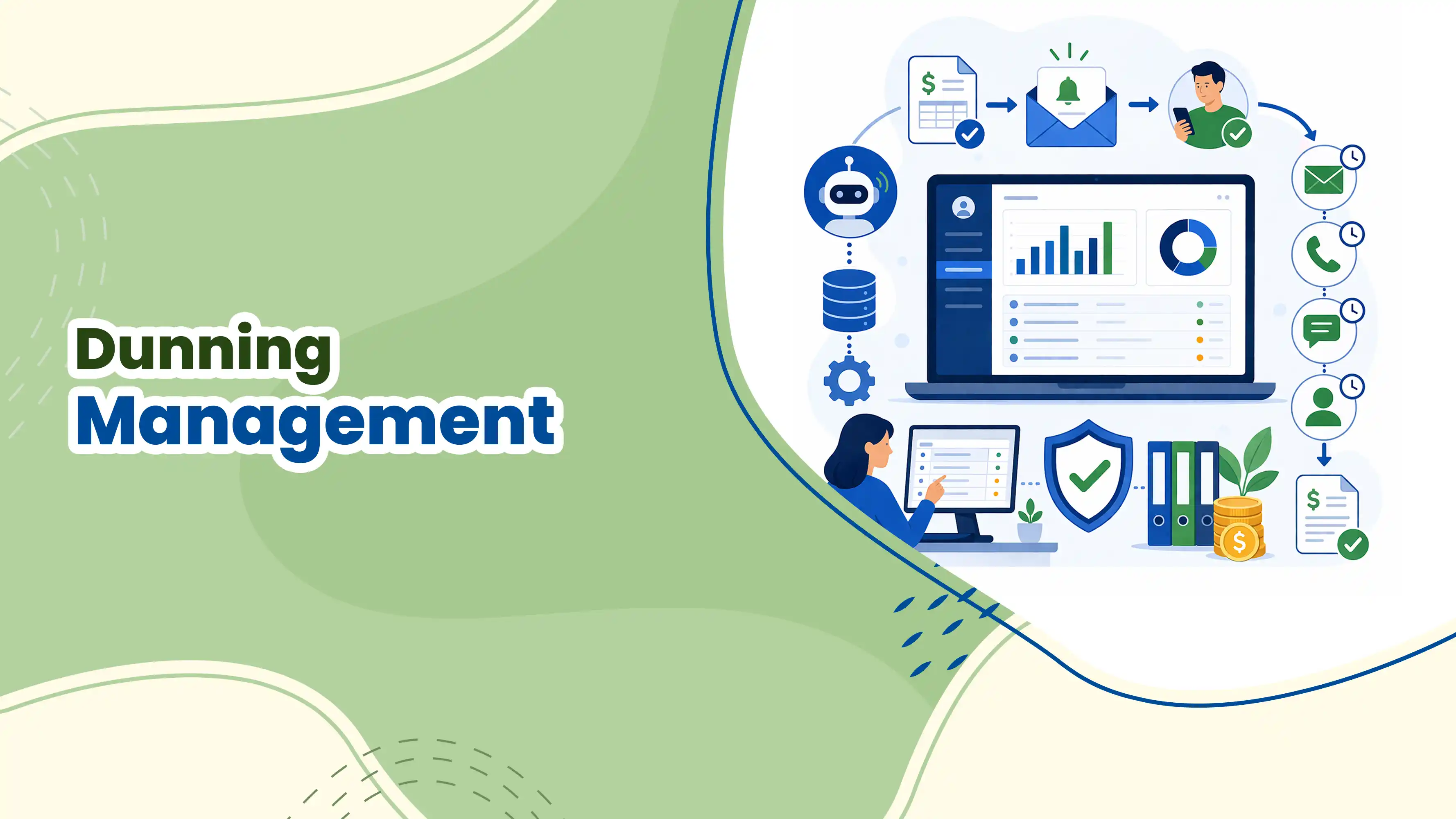
QUICK ANSWER: WHAT IS DUNNING MANAGEMENT?
Dunning management is the structured process of reminding, following up with, and escalating
communication to customers with overdue invoices to ensure timely payment. It includes pre-due
reminders, overdue notices, dispute handling, and escalation workflows. An effective dunning process
helps reduce Days Sales Outstanding (DSO), improve cash flow, lower bad debt risk, and strengthen
accounts receivable collection performance.
Your oldest receivables aren't just an accounting problem. They're a signal that something in your
collection process broke down, and it usually broke down quietly, somewhere between the first missed
payment and the moment someone finally escalated.
That gap is where dunning management lives. And for most US finance teams, it's either running on
autopilot with generic email templates, or it's not really running at all. Controllers are chasing the
same accounts manually every quarter. Collectors are copy-pasting reminder emails. And customers with
genuine payment issues are getting the same message as chronic late-payers.
Done right, dunning management is one of the highest-leverage activities in your AR process. It shortens
your collection cycle, reduces write-offs, and gives finance leadership real visibility into who's
actually going to pay. Done poorly, it costs you customers and cash at the same time.
What Dunning Management Actually Means (And What It Doesn't)
The term gets used loosely. Some teams think dunning means sending payment reminder emails. Others treat
it as the nuclear option: the final warning before collections or legal action. It's neither.
Dunning management is the systematic process of communicating with customers at every stage of invoice
delinquency, with escalating urgency and appropriate actions tied to each stage.
That word "systematic" matters. It's not a one-off email blast. It's a structured workflow that starts
before an invoice is even overdue, moves through progressively firmer outreach, and ends with a clear
decision point about whether to escalate, write off, or keep working the account.
In practice, a well-run dunning process covers:
- Pre-due reminders (3 to 5 days before the invoice due date)
- Day-of-due notifications
- Short-term overdue outreach (1 to 15 days past due)
- Mid-range delinquency follow-up (16 to 45 days)
- Long-term escalation (45 to 90 days)
- Final demand or pre-collections handoff (90+ days)
Each stage should have a defined message, a defined channel, and a defined next action if the customer
doesn't respond. That's the part most teams skip. They send a few emails, and then someone has to remember
to follow up again, and that someone has 200 other accounts to manage.
Why Most Dunning Processes Fail in Practice
Here's the thing about dunning failures: they rarely happen because the team doesn't care. They happen
because the process wasn't built for scale.
Picture your controller on a Friday afternoon. Thirty-two invoices just ticked past 30 days. Fourteen of
those accounts have open disputes attached. Six are customers who've promised to pay for the third time
this quarter. The controller has to triage manually, pull aging reports from the ERP, cross-reference
notes in a spreadsheet, draft individualized emails for the ones that actually need personalization, and
somehow make judgment calls about escalation, all while managing everything else on their plate.
That's not a performance problem. That's a process problem.
The most common breakdowns look like this:
- Inconsistent timing: Reminders go out whenever someone
gets to them, not on a defined schedule. Customers learn that your payment terms are more "suggestion"
than policy.
- Generic messaging: Every customer gets the same
template regardless of relationship history, payment behavior, or dispute status. A good customer who
made a one-time banking error gets the same tone as a chronic slow-payer.
- No channel strategy: Email is the default, but some
customers respond to phone, some to portal notifications, some to a direct message from their account
manager. Most teams never vary the channel.
- Disconnected data: The collections team can't see open
disputes in real time. The dispute team doesn't know which accounts are in escalation. Finance
leadership sees a 30-day-old snapshot.
- Manual escalation decisions: No defined rules for when
to pull in credit management, when to put a customer on credit hold, or when to involve legal. Each
escalation is a judgment call made under time pressure.
The result? DSO creeps up, write-offs increase, and finance leadership spends board meetings explaining
variance they can't fully account for.
If any of that sounds familiar, you're not alone. The accounts receivable management
challenges that enterprise teams deal with are almost universally rooted in process gaps, not people
gaps.
The Anatomy of an Effective Dunning Sequence
Getting dunning right means designing the sequence before you ever send the first email. Here's what a
high-performing structure actually looks like.
Stage 1: Pre-Due Reminders (Day -5 to Day 0)
This is the most underused stage in US enterprise collections. Most teams wait until an invoice is
overdue to reach out. That's too late.
A pre-due reminder does two things: it surfaces any disputes or payment issues before they delay payment,
and it signals to the customer that you're paying attention. Something as simple as "Your invoice for
$42,000 is due in 5 days. Here's the easiest way to pay" reduces late payments meaningfully, especially
for customers managing their own cash flow timing.
Stage 2: Early Overdue (Day 1 to Day 15)
This is where most dunning sequences live, and where most of them stall. The first overdue reminder
should be firm but not aggressive. Assume good faith. Give the customer an easy path: a direct payment
link, a clear contact for questions, and a deadline.
By Day 7 or Day 10, if there's no response, you shift the tone. Not threatening. Just more direct. "We
haven't heard back" carries weight without torching the relationship.
Stage 3: Mid-Stage Escalation (Day 16 to Day 45)
This is where you start differentiating. A high-value, historically reliable customer who went quiet at
20 days probably needs a phone call from a relationship manager, not another automated email. A chronic
late-payer at Day 30 might need a credit hold warning.
The problem is that manual processes can't make this distinction at scale. Everyone gets the same message
because there's no system tracking individual payment behavior.
Stage 4: Late-Stage and Pre-Collections (Day 45+)
At this point, you need clear escalation rules and you need them documented. When does the account go to
a senior collector? When does it trigger a credit review? When does it go to legal or a third-party
collections agency? When does it get written off?
Every finance team should be able to answer those questions in five minutes. Most can't answer them in a
week.
Before vs. After: What Automated Dunning Actually Changes
Manual Dunning
- Reminders sent when someone gets to them
- Same template for all customers
- Collectors manually track follow-up dates in spreadsheets
- No visibility into dispute status during collections
- Escalation decisions made case-by-case with no documented
criteria
- Finance leadership sees aging reports weekly or monthly
Automated Dunning
- Reminders trigger automatically based on defined rules and
customer segments
- Message tone, channel, and timing vary based on customer
history and account value
- Every touchpoint is logged and visible in real time
- Disputes surface automatically and pause collection activity
on disputed invoices
- Escalation rules are pre-configured and applied consistently
- Finance leadership sees live dashboards with account-level
detail
The gap between those two lists isn't marginal. For companies processing hundreds or thousands of
invoices a month, it's the difference between 45-day DSO and 30-day DSO. On $50 million in AR, that's real
working capital.
How AI Is Changing the Dunning Equation
The traditional view of dunning automation was rule-based: if invoice is X days past due, send template
Y. That was better than nothing, but it still treated all customers the same and couldn't adapt.
What's changed is the AI layer. AI-powered collections agents can now analyze payment patterns across an
entire customer portfolio, identify which accounts are likely to pay without intervention, which ones
respond to specific outreach channels, and which ones show early signs of credit risk, before they hit 90
days.
That kind of intelligence changes the dunning conversation. Instead of sending reminders to everyone and
hoping for the best, you're targeting outreach where it actually moves the needle.
Quick Receivable, a Salesforce-native AR
automation platform, uses AI agents for Collections, Dispute Management, and Credit Management working in
coordination. When a dispute surfaces on an account in the middle of a dunning sequence, the collections
workflow automatically pauses on that invoice while the dispute is being resolved. When the dispute
closes, the dunning sequence picks back up at the right stage. Without that coordination, collectors often
dunning customers for invoices that are legitimately under review, which damages relationships and slows
payment on everything else.
Dunning Management and Dispute Resolution: Why They Have to Work Together
This is one of the most overlooked integration points in AR. Dispute management and dunning management
are usually run by different people, sometimes different teams, and almost never on the same system.
The downstream effect is painful. A customer disputes an invoice. The dispute team opens a ticket. The
collections team, working off an aging report that doesn't reflect dispute status, continues dunning the
customer for the disputed amount. The customer gets frustrated and starts deprioritizing your invoices
entirely, including the ones they don't dispute. You've turned a billing problem into a relationship
problem.
Dispute management in
accounts receivable needs to be a first-class part of your dunning workflow, not a parallel track.
The fix isn't complicated conceptually. You need a single system where dispute status is visible to
collectors in real time, where dunning rules can automatically exclude disputed invoices, and where
dispute resolution triggers the right next step in the collections sequence. The complication is that most
legacy AR systems weren't built that way.
The DSO Connection: What Better Dunning Actually Does to Your Numbers
Finance leaders sometimes treat dunning as a tactical collections issue. It's not. It's a DSO issue. And
DSO is a cash flow issue.
Every extra day of DSO ties up working capital. For a mid-market company with $100 million in annual
revenue, one day of DSO improvement frees up roughly $275,000 in cash. Ten days is $2.75 million. The math
isn't complicated, but the operational changes required to get there often are.
Reducing days
sales outstanding consistently requires three things working together: faster invoice delivery,
cleaner dispute resolution, and more effective dunning. Most organizations fix one or two of those and
wonder why DSO isn't moving. Dunning is usually the last piece that gets serious attention, which is
backwards given how much leverage it has.
The accounts
receivable cash flow relationship is direct: shorten your collection cycle, and your operating cash
position improves without any change in revenue. That's a CFO-level outcome, not just an operations win.
What to Look for in a Dunning Management Solution
If you're evaluating platforms, the checklist matters. Not all dunning automation is created equal.
Here's what actually separates good solutions from ones that add complexity without results.
Segmentation capabilities: Can you define different dunning sequences for different customer
segments? Top-tier accounts with long histories should not get the same treatment as new customers with no
payment track record.
Multi-channel outreach: Email is necessary but not sufficient. A real solution supports email,
SMS, phone task automation, and portal notifications with routing logic tied to customer preferences.
Dispute awareness: The dunning engine has to be able to read dispute status and pause or modify
collection activity accordingly. This is non-negotiable if you have meaningful dispute volume.
CRM integration: If your sales team has context on a customer relationship (an open negotiation, a
service issue, a strategic account status), that information should flow into collections decisions. For
Salesforce shops, a Salesforce-native AR automation platform gives you that connection without custom
integration work.
Escalation rules: Pre-defined, auditable escalation criteria that trigger credit holds, management
review, or collections handoffs based on rules, not guesswork.
Real-time reporting: You should be able to see exactly which accounts are in which dunning stage,
what outreach has gone out, what's been opened, and what's responded. Yesterday's aging report isn't
enough for managing an active collections cycle.
If you want to understand what these capabilities look like in a live environment, it's worth looking at
Quick Receivable's features or running
the AR ROI
calculator to get a sense of the financial impact.
A Note on Customer Relationships: The Tension You Have to Manage
Real talk. Dunning done poorly will cost you customers. Not just their payments, but the relationship
itself. Finance leaders sometimes get so focused on the mechanics of the collection process that they
forget the customer on the other end is evaluating whether they want to keep doing business with you.
The best dunning programs are firm and respectful at the same time. They communicate clearly. They make
it easy to pay. They acknowledge when there's a problem. And they escalate in a way that feels measured
rather than punitive.
Customers who've had bad experiences with aggressive, impersonal dunning will find ways to deprioritize
your invoices. Customers who feel like their vendor is a professional, organized partner are more likely
to keep you at the top of their payment queue, especially when their own cash position is tight.
The tone of your dunning communications is a brand decision, not just a collections decision.
Conclusion
Dunning management doesn't get the board meeting time it deserves relative to the impact it has on cash
flow. But controllers and CFOs who've actually tightened up their dunning process know what shows up on
the other side: a shorter collection cycle, cleaner AR aging, fewer write-offs, and more predictable cash.
The gap between where most teams are and where they could be isn't about working harder. It's about
replacing manual, inconsistent processes with structured, data-driven workflows that scale without adding
headcount.
Whether you're running 500 invoices a month or 50,000, the fundamentals are the same: right message,
right customer, right time, with dispute awareness built in and escalation rules that actually get
followed.
If your current dunning process is running on spreadsheets and good intentions, it's worth seeing what a
properly configured automation platform can do for your numbers. You can schedule a demo with the Quick Receivable team to walk through what the
implementation looks like and what kind of DSO improvement is realistic for your portfolio.
Frequently Asked Questions
Dunning management is the structured process of communicating with
customers at each stage of invoice delinquency, from pre-due reminders through escalation. It
matters for cash flow because it directly controls how long invoices stay unpaid. A well-run
dunning process typically reduces DSO by 5 to 15 days, which frees up significant working
capital without any change in revenue or pricing. Most companies underestimate how much their
collection timing affects operating cash.
Dunning emails are one tactic within a broader process. Full dunning
management includes pre-due reminders, staged escalation sequences, customer segmentation,
multi-channel outreach, dispute-aware collection logic, and defined escalation rules for when
accounts should go to credit management or a collections agency. Teams that only run reminder
emails without the surrounding structure typically see inconsistent results and miss the
behavioral triggers that indicate a customer is heading toward serious delinquency.
They're closely linked, and the failure to connect them is one of the most common AR mistakes.
If your collections team is dunning a customer for an invoice they've legitimately disputed,
you're damaging the relationship and slowing payment on every other invoice in the account. A
properly designed AR system pauses dunning activity on disputed invoices and resumes the
sequence once the dispute is resolved. Without that integration, you're working against
yourself.
The clearest signals are a DSO that keeps creeping up despite normal
revenue patterns, aging reports with a growing bucket of 60 to 90 day receivables, collectors
who spend most of their time on manual outreach instead of escalation decisions, and frequent
customer complaints about conflicting communication. If your team can't tell you within five
minutes exactly which dunning stage each account is in, that's also a sign the process isn't
structured enough to be manageable.
Yes, and for companies already using Salesforce as their CRM, a
Salesforce-native AR automation platform is often the cleanest path. It means customer data,
relationship context, and collection history all live in one system. Sales reps can see
account-level collection status. Finance can see open disputes alongside dunning stage. There's
no data sync lag between systems. Quick Receivable is built natively on Salesforce, so the
integration isn't an add-on. It's the architecture. Companies typically go live in about four
weeks, compared to nine to twelve months for legacy AR platforms.
 Shyam Agarwal